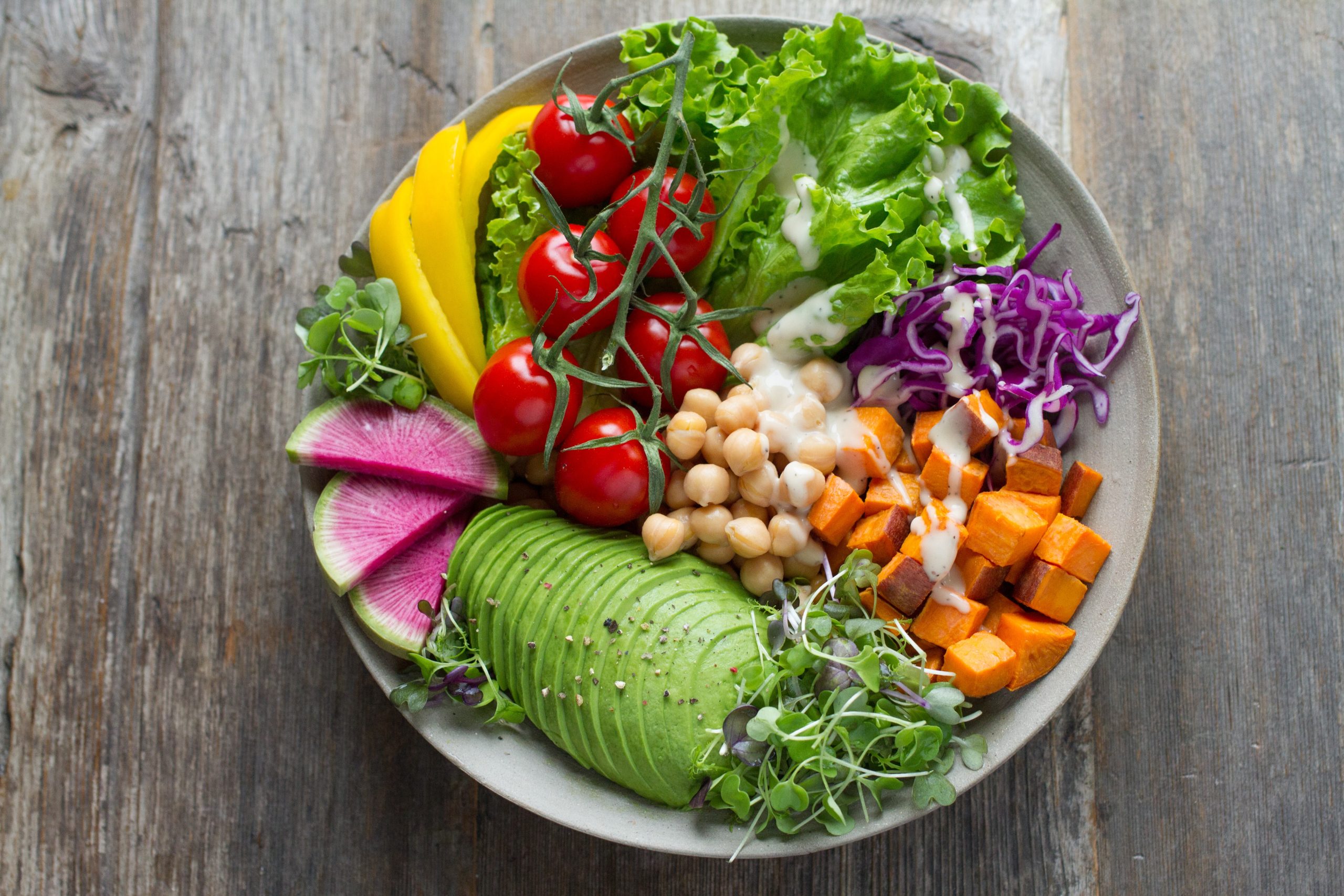
Reviewed and updated: February 2026
Sometimes we go looking for the perfect supplement, the perfect recipe, or the next “star ingredient”… and we miss what’s simplest: adding more plant variety. Not because it’s trendy, but because when your plate holds more real colour, something very practical tends to happen—meals feel more satisfying, you get more micronutrients per bite, and for many people that “something’s missing” feeling after eating quiets down.
That’s where phytonutrients come in: natural compounds found in plants that aren’t vitamins or minerals, but still support functions we care about (inflammation balance, vascular health, metabolic resilience). The rainbow diet isn’t a strict plan or a perfection challenge. It’s a gentle rule of thumb to build more variety—without turning food into homework.
In my clinical work, I often see the same thing: when we stop chasing “perfect” and simply add more plant variety, eating well becomes much easier to sustain.
In this article, I’ll explain what phytonutrients are, how the “rainbow” works by colour, and—most importantly—how to apply it in real-life weeks with practical shortcuts (no obsession, and with room for your digestion and your context).
The essentials in 30 seconds
Phytonutrients are natural plant compounds (not vitamins or minerals), but they add up when plants show up regularly.
The rainbow diet isn’t strict: it’s a simple way to increase variety without obsessing.
You don’t need to “eat perfectly”—2–3 colours a day already builds a richer, repeatable base.
Many phytonutrients are better absorbed with the right cooking and a little healthy fat (extra-virgin olive oil, nuts, avocado).
If your digestion is sensitive, tolerance comes first: choose cooked options, smaller portions, and repeat what sits well.
What are phytonutrients?
Phytonutrients (also called phytochemicals) are bioactive compounds that plants produce to protect themselves—from sunlight, insects, and environmental stress. You’ll find them in fruits and vegetables, but also in legumes, whole grains, nuts, seeds, herbs, and spices.
They’re not classified as “essential nutrients” like vitamins or minerals, but they’re studied for their antioxidant activity and for how they may help modulate processes linked to inflammation balance, vascular health, and metabolism—especially when they’re part of an overall plant-rich pattern.
Real-life translation: you don’t need to memorise names (lycopene, anthocyanins…). What matters is this: more plant variety = more types of phytonutrients. The easiest way to do that—without overthinking—is to look at your plate and ask: What colour am I missing today?
When phytonutrients are missing from the diet
For many people, the hard part isn’t knowing what to do. It’s sustaining it in real-life weeks. Between schedules, fatigue, and decision overload, the plant side of the plate can shrink to the minimum: the same salad, the same two vegetables… and not much else.
When fruit and vegetable intake is low (or not very varied), it’s not only vitamins and minerals that drop. Something quieter drops too: the diversity of phytonutrients reaching your body. And that diversity matters, because different plants bring different compounds.
The goal here isn’t to chase numbers or do it perfectly. The goal is to build variety with a simple method. That’s why the rainbow idea works: it helps you step out of autopilot and add different colours—without turning food into a project.
Practical rule: if your plate feels a bit “beige” today, add one easy colour (cooked tomato, leafy greens, berries, squash, red onion…). Small changes, repeated, tend to do much more than an ideal plan you can’t sustain.
Now—let’s go colour by colour: what each group offers, and how to use it in everyday life.
Colours & benefits: a supportive rainbow
Red
- What it tends to offer: lycopene and other antioxidant compounds.
- Where you’ll find it: tomatoes, watermelon, pink grapefruit, red peppers, strawberries.
- How to get the most from it (no rituals): lycopene from tomatoes is better absorbed when the tomato is cooked and paired with a little fat.
Easy idea: a quick tomato sauce (or gently cooked crushed tomatoes) with extra virgin olive oil and oregano.
Integrative note: if vegetables feel hard to fit in, cooked tomato is a simple “go-to” you can repeat often.
Orange
- What it tends to offer: beta-carotene and alpha-carotene (pro-vitamin A).
- Where you’ll find it: carrots, squash/pumpkin, sweet potato, mango, apricots.
- How to get the most from it: roasted, steamed, or blended into a soup + a drizzle of extra virgin olive oil or a spoon of tahini.
Easy idea: roasted squash with olive oil and cumin (enough for 2–3 days).
Integrative note: if you eat very little fat, these pigments can be easier to miss (they’re fat-soluble). You don’t need much—just a drizzle of olive oil helps.
Yellow
- What it tends to offer: lutein and zeaxanthin (often discussed in relation to eye health).
- Where you’ll find it: yellow peppers, corn, egg yolk—and also leafy greens (even though they’re green, they contribute here too).
- How to get the most from it: add a bit of healthy fat to salads or sautéed vegetables (olive oil, avocado).
Easy idea: sautéed spinach with olive oil + an egg (or corn in a warm salad).
Integrative note: if vegetables feel like “too much” today, an egg with some leafy greens is still a colour win.
Green
- What it tends to offer: glucosinolates (from cruciferous vegetables) and other compounds of interest for antioxidant and inflammation balance.
- Where you’ll find it: broccoli, cauliflower, cabbage, Brussels sprouts, arugula/rocket, kale.
- How to make it gentler on digestion: steam or do a quick sauté. If it bloats you, start with smaller portions and cook a bit more.
Easy idea: steamed broccoli with olive oil + lemon + salt.
Integrative note: the goal isn’t “how much you can tolerate.” The goal is to rebuild calm: a little, well cooked, and repeated.
Purple / Blue
- What it tends to offer: anthocyanins (especially in berries and dark grapes).
- Where you’ll find it: blueberries, blackberries, dark grapes, eggplant, red onion, red cabbage.
- How to include it without overthinking: frozen berries count—and they’re genuinely convenient.
Easy idea: frozen berries with yogurt/kefir (if you tolerate it), or with oats/chia.
Integrative note: if you’re craving something sweet, this is a “dessert” that adds something, without becoming a project.
White / Brown
- What it tends to offer: lignans (flax/sesame) and other “quiet” compounds (garlic, onion, mushrooms).
- Where you’ll find it: flaxseed, sesame, garlic, onion, leeks, mushrooms.
- How to get the most from it: flax works best ground (whole seeds often pass through without being fully digested).
Easy idea: 1 tablespoon of ground flax in yogurt, porridge, or a smoothie.
Integrative note: the power here isn’t doing it perfectly—it’s letting it show up often, even in small amounts.
Clinical note: this approach is designed to help you eat more plants without obsessing. If you’re in a very reactive IBS phase, recovering from recent digestive surgery, or following a highly specific clinical diet (e.g., advanced kidney disease), it’s worth adjusting fibre type, portions, and food format with professional support.
How to add more phytonutrients: 6 practical steps (for real-life weeks)
1. Start by adding (not by aiming for perfect)
If you’re currently eating very little fruit or veg, don’t jump from 0 to 9 servings overnight. It usually works better to add one concrete thing and repeat it.
Example: a piece of fruit at breakfast, or a vegetable soup at dinner. Once that feels easy, you add the next step.
2. Create a “colour map” you actually like
You don’t need long lists. Pick 2–3 foods per colour that you genuinely enjoy and already use:
Red: cooked tomatoes, strawberries
Orange: carrots, squash/pumpkin
Green: broccoli, spinach
Purple: berries, red onion
White/brown: garlic, ground flax
With this, variety happens with less thinking.
3. Simple rule: 2–3 colours a day is enough
You don’t need a full rainbow on every plate. In real life, it’s more sustainable to aim for:
2 colours a day as your base
+1 extra colour when you can
A quick broccoli + carrot stir-fry already counts. Perfection isn’t the goal.
4. Rotate the format based on your digestion
Some days raw foods feel great. Other days they don’t—and that’s okay.
If digestion is sensitive: steamed, blended (soups), gentle sautés often sit better.
If you’re doing well: salads, crudités, fresher bowls.
Tolerance leads. What matters most is what you can repeat.
5. Add healthy fat when it makes sense
Many plant pigments are absorbed better with fat. You don’t need much:
extra-virgin olive oil (drizzled)
a small handful of nuts
seeds
avocado
Easy idea: vegetables + a drizzle of olive oil. Done.
6. Keep a few shortcuts at home so variety happens by default
This is what changes day-to-day life the most:
Frozen berries (purple)
Crushed tomatoes or homemade tomato sauce (red)
A bag of frozen vegetables (green)
Frozen peas (green) for quick rice, sautés, and soups
Practical shortcuts: the rainbow without cooking more
3 no-effort snacks that add phytonutrients
Plain yogurt or kefir (if tolerated) + berries + nuts/seeds
Fruit + a small handful of nuts
Hummus + carrot or cucumber sticks (or, if you prefer cooked: steamed carrots)
3 colourful “base meals” you can repeat
Warm bowl: quinoa/rice + a green veg + an orange veg + extra virgin olive oil
Warm salad: leafy greens + tomato + red onion + protein + olive oil
Soup + topping: pumpkin or zucchini soup + olive oil + seeds (and, if needed, a simple protein)
Integrative note: if you don’t have the energy today, don’t go looking for inspiration. Pick a shortcut and repeat it. Sustainability builds the foundation.
Beyond the rainbow: how this can fit with “longevity” frameworks
The rainbow is a tool for plant variety. Once that base is in place, it often fits naturally with approaches that focus on essentials too: more plants, fewer ultra-processed foods, and a pattern you can actually sustain.
Some “longevity diet” frameworks also emphasise protein awareness and strategies like time-restricted eating. They can be useful—but they aren’t universal, and they’re not always the right first step. What makes sense depends on context (age, muscle mass, activity level, symptoms, medication, and your current season of life). That’s the Slow approach: not for everyone, and not for every moment.
Real-life translation: before you think about fasting windows or finer rules, it usually matters more to make sure that:
you’re getting fruit and vegetables consistently,
you have enough protein for your context, and
your meals leave you steady and nourished—not tense.
If you’d like to explore that approach in more detail, you can read my article on the Longevity Diet.
Conclusion
The rainbow approach isn’t about “eating perfectly” or collecting superfoods. It’s about something much simpler: increasing plant variety in a way you can sustain. Phytonutrients show up when your plate fills with real colours—and that often translates into more nutrient density, more flavour, and (for many people) a quieter relationship with food.
If you’re far from that right now, it doesn’t have to be epic. Start with one easy colour (cooked tomato, frozen berries, a steamed crucifer, ground flax…) and repeat it. Small changes, sustained, become your foundation.
FAQs
What exactly are phytonutrients?
They’re bioactive compounds produced by plants (phytochemicals). They aren’t vitamins or minerals, but they’re studied for their antioxidant activity and for how they may modulate processes linked to inflammation balance, vascular health, and metabolism within an overall plant-rich pattern.
Is the “rainbow diet” an actual diet?
Not really. It’s a practical rule of thumb to increase variety: look at your plate and add different colours across the day. It doesn’t need to be perfect.
How many servings of fruit and vegetables should I eat per day?
As a population guideline, the WHO recommends at least 400 g/day (roughly 5 portions) for people over age 10. If you’re not there yet, it often works better to add one portion and make it consistent.
Do frozen fruits and vegetables count?
Yes. They’re one of the easiest ways to make variety sustainable (berries, peas, mixed vegetables).
Why do you recommend olive oil or fat with some vegetables?
Because many pigments (such as lycopene and carotenoids) are fat-soluble, and absorption improves when they’re eaten with dietary fat.
If I cook vegetables, do I lose phytonutrients?
It depends on the compound and the cooking method. In practice, what matters most is what you can repeat: if cooked vegetables sit better and help you eat more plants consistently, cooked wins.
What if cruciferous vegetables (broccoli, cauliflower) bloat me?
Go with smaller portions, gentler cooking (steam or soup), and avoid stacking lots of fermentable foods in the same meal. The goal is calm first, range later.
Is flaxseed better whole or ground?
Ground is usually better, because you absorb more. If digestion is sensitive, start small and build slowly.
If you’re at a point where you need clarity and structure, I can support you with a personalised consultation to adapt these guidelines to your needs.
References
World Health Organization. Healthy diet. WHO; updated 26 Jan 2026.
Nam Y-E, Hwang I-G, Jang H-H. Role of lycopene from tomato on cardiovascular risk: an umbrella review of systematic reviews and meta-analyses of intervention studies. Food Funct. 2026. Jan 26;17(2):622-630. doi: 10.1039/d5fo04213e. PMID: 41369612.
Costa-Pérez A, et al. Systematic Review on the Metabolic Interest of Glucosinolates and Their Bioactive Derivatives for Human Health. Nutrients. 2023 Mar 15;15(6):1424. doi: 10.3390/nu15061424. PMID: 36986155; PMCID: PMC10058295.
Khani S, Spencer J. A systematic review of the mechanisms of cardiovascular disease reduction by dietary flavonoids: the impact of anthocyanins on flow-mediated dilation and blood rheology. BMC Nutr. 2025 Oct 23;11(1):195. doi: 10.1186/s40795-025-01086-2. PMID: 41131574; PMCID: PMC12548122.
Deng B, et al. Blueberry intervention on endothelial function in adults: a systematic review and meta-analysis. Front Physiol. Volume 15 – 2024 | https://doi.org/10.3389/fphys.2024.1368892
Moghadam EF, et al. Flaxseed lowers blood pressure in hypertensive subjects: A Meta-Analysis of Randomized Controlled Trials. Clin Nutr Res. 2024 Oct 29;13(4):295-306. doi: 10.7762/cnr.2024.13.4.295. PMID: 39526211; PMCID: PMC11543448.
Yuanhang Yao, Peiyi Tan, Jung Eun Kim, Effects of dietary fats on the bioaccessibility and bioavailability of carotenoids: a systematic review and meta-analysis of in vitro studies and randomized controlled trials, Nutrition Reviews, Volume 80, Issue 4, April 2022, Pages 741–761, https://doi.org/10.1093/nutrit/nuab098
Hajeer W, et al. Recent advances in carotenoid absorption, distribution, and elimination, Biochimica et Biophysica Acta (BBA) – Molecular and Cell Biology of Lipids, Volume 1870, Issue 5, 2025, 159619, ISSN 1388-1981,